Dusky Dan Ellis Roadshow
by Mike Hackett
Dan Duskey was a showman with a small travelling outfit of his own – going from village to village in the earlier part of the last century. His wife, Peggy, sons and daughters made up the entire cast. There are many stories about the hard-working Dan and his village show while touring around the South of Ireland. He arrived in Clashmore village in West Waterford before the Second-World-War with a van pulling one wagon. His theatre at the time was a one-pole all-canvas tent and it was one that had seen better days. Dan was undeterred. It was all that he could afford and he set up just below the bridge. A few people ventured in to see the first night’s performance and to test the talent. They were the local ‘experts’ who would not miss a show of any kind. A travelling troupe could be accepted – or quickly dismissed – on the reports of the ‘critics’. Then after the show – sitting on the bridge wall – the performance would be discussed like an inquest that went on late in – to the night. After all – this was an exciting unusual happening in a small community.
Meanwhile at the show – the performers were going to bed – hoping that the reports would be good. It would mean a few weeks of regular income and some stability of life for the family. No taking down the tent – no travelling and no re-erecting in the immediate future. Then more importantly – it was a chance for the kids to attend school and make new friends with other kids. You had shops to become familiar with people to smile at – and a community to belong to – if only for a month or so. The next-day feed-back was good and the attendances began to improve after every performance. Dan Duskey and his show was welcomed. Then the energy saved by not moving on was put into rehearsals every afternoon – to ensure the freshness of change. Survival demanded that the small population did not become bored and this was uppermost in the performers’ minds. So a different programme was given nightly. Eventually the fear of staleness led on to the local talent contests. Locals were now entertaining themselves with the means and encouragement coming from the professionals. Remarkably, the audiences at the talent shows often surpassed those of the regular performances – as mothers, fathers, brothers and sisters poured in from the surrounding country-side. Of course their Johnny or Paddy – in their eyes – was definitely the best. Talent contests would often discover real hidden ability and start singers on the road to stage musicals and plays. Then for the final – a judge would be sought from some other parish to do the honours – and if the favourite didn’t win – the harmony of the village would not be upset. But regardless of the result – it was now time to move on to another village, new faces – another school, new teachers.
During the Second-World-War – Dan, like all civilians could get little petrol for his van and had to change back to animal power. A donkey and dray were then bought to help the travelling show to move. On steep hills – the animal would be helped by Dan to pull the load. This was done by tying a rope onto the shafts of the dray and Dan would walk ahead while pulling on it. A local postman named Tom Bagge encountered this scene on Lickey Bridge near Piltown as Dan was assisting the donkey. “That’s a great donkey that you have there” said Tom. “He’s not as good as the other donkey” replied the showman. “What other donkey” asked Tom. “The two-legged donkey walking in front of him” said Dan. It was during a later return visit to Clashmore that the show got a great boost from Michael Kenure – a village merchant. A real considerate and charitable man was the same Michael. He had seen how hard Dan worked to keep the show going and how much it meant to the morale of the people of the area. Performances were being held during this visit in an old all-canvas marquee that was full of holes – with the rain dripping in. Michael Kenure drove to Cork City – bought a new canvas – and presented it to Dan Duskey that evening. Following that kind gesture – and to show Dan’s gratitude – the first performance under the new cover was admission free. Tears of happiness were in Dan’s eyes that night as he profoundly thanked his benefactor and the people of Clashmore for their tremendous support and friendliness over many decades. The show then moved on to Youghal Town – where there were hundreds of soldiers in the army barracks. Even though the town had two cinemas – Dan’s live show was packed every night and so he got his share of the pay-packets. After that, it was off to nearby Ballymacoda – where more soldiers were billeted. Again it was full attendances and many enjoyable weeks were spent there. Years later – the Duskeys managed to buy a hippodrome booth. It had timber sides and was warmer and cosier. This new ‘house’ was very secure on windy nights and it meant that the performance could be held almost regardless of the weather.
Sandy Kelly (Duskey)
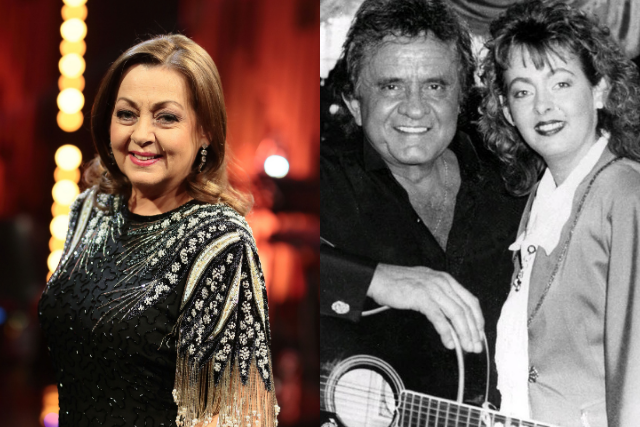
Sandy (Duskey) Kelly – now a famous singer on T.V. and who has appeared with Johnny Cash – is a grand-daughter of Dan. He would be proud. A native of Sligo, Sandy Kelly, real name Philomena Ellis, put together her first cabaret group called Sandy Duskey and Easy Listenin’,consisting of the following band members: Sandy Kelly on vocals, Gerry Gallagher from Magic and the Kim Newport Band) on bass guitar. Gerry Feeney from Dee Leydon and The Powermen) on keyboards, and Ballysadare drummer Sean Savage. The band toured the North-West of Ireland and became an instant success.
Sandy, who took her stage name from her family which toured the English clubs as The Duskey Family, was quickly spotted by Ballina manager Tom Kelly, who offered her a spot with his band, The Fairways after the departure of their female vocalist Karen King. Hawk Records immediately signed Sandy and the band to a contract and her first single was released, Come Back Billie Jo, a country number and a major departure for the more hard edged Fairways. For the next two years, the band went by the name of Gary Street, Sandy Duskey and the Fairways, as time passed, Sandy‘s talent showed through, earning more fans for herself and the band. Towards the end of the 1970’s, Tom Kelly brought Sandy‘s sister, Barbara into the band, along with her cousin from Wales, Nina, real name Marian and they became the Duskey Sisters and the Fairways.
The Duskey Sisters
With their continued success as the Duskey Sisters, the band soon dropped the use of the Fairways name and became know as just The Duskey Sisters, going on to take the ballroom scene by storm. Playing bass guitar in the band was Tom Kelly‘s brother, Michael, who was soon dating and who eventually married Sandy. In 1981, The Duskey Sister’s got their first crack at Eurovision when they sang, Where Does That Love Come From in the Irish National Song Contest, coming third in the competition behind another trio of females called Sheeba. The following year the band was again competing in the National Song Contest singing the Sally Keating song Here Today, Gone Tomorrow, with the band winning the contest and going on to represent Ireland in The Eurovision Song Contest . The record went to number 12 in the Irish charts, but its success was short lived. Joining the girls for the contest, and subsequently on tour for a short time, was Danny Duskey, another of Sandy‘s cousins from Wales. Although they didn’t win at Eurovision, the success convinced Sandy that she had what it would take to make it internationally.
The Sandy Kelly Band
A serious road accident in 1983 put Sandy and the band off the road and although at the time, there was no immediate plan to change the band’s direction, Sandy took the break while she recovered to make the changes needed to move from pop to country music. By the mid 1980’s, the ballroom scene in Ireland had been hit hard by discos and Sandy decided it was time to go back to her roots in cabaret and country music and to change to her married name, Sandy Kelly.
In early 1989, Sandy reluctantly recorded the Patsy Cline standard, Crazy. Reluctantly because at the time she was doing country rock and original material, and she “felt that Crazy belonged very much to Patsy Cline“. The record went on to be Number 13 in the Irish charts and became the country’s biggest selling record of 1989. Since then Sandy has achieved international stardom, performing and touring with top artists like Johnny Cash and George Hamilton IV as well as touring Ireland with her own show and presenting her own radio programme on Sligo‘s Ocean FM.
The Ellis family had a 'fit-up' travelling roadshow.
By Sandy Kelly.
The Early Days
Much-loved Irish singer, Sandy Kelly was always going to be a singer and performer. Born into her grandfather, Dusky Dan’s Variety Roadshow, her destiny was sealed from her first stage appearance at the age of three, laying the foundations for a lifelong career in music.
She was co-opted into the family travelling fit-up variety show in Ireland and later as a teenager on the social club circuit in the U.K. playing an ever more prominent role until she returned to Ireland and developed initially as a pop performer before following her instincts and concentrating on a country music career.
Sandy Kelly has had many remarkable moments in her lengthy musical career. Born Philomena Ellis, in Sligo, in 1954, she had one younger sister, Barbara, who sadly passed away in October 2018, and her baby brother, Francis, who died when he was five months old. Her family business was a ‘fit-up’ roadshow which travelled the country entertaining people long before cinema came to rural Ireland. “I was born into a family of travelling entertainers, or ‘fit-ups’ as we were called. My grandfather, originally from Belfast, was the founder of the Dusky Dan Variety Show, and my father, Frank, who passed away in January 2013, carried on the tradition. There was no cinema or television in rural Ireland back then so crowds flocked to our visiting roadshows. One of my first memories is of arriving in a village on a horse-drawn trailer. The ‘venue’ would consist of a small canvas circus-like tent for the show. We lived in the caravans that travelled the countryside”.
“Now, I realise that I was moulded like a robot for showbiz which, looking back, wasn’t always such a good thing for a child. I quickly learned the value of applause. For a while, I didn’t appreciate the fact that I was an entertainer. I wanted to be a ‘regular person’ living in a house, going to school and church, so when I was nine I went to live with my grandmother. My classmates called me ‘the showman’s daughter’. I even studied accountancy for a while — but I ran back on stage when I realised I could earn more in one night with my father’s band than I could in a week at a normal job. The best advice I ever got was from my grandfather, Dan Ellis — ‘never make excuses when you go out on stage’. To this day I never do. I go out to entertain and take the audience away from their worries. They don’t want to hear about my problems”.
A stroke of luck
Sandy Kelly was sitting in a local radio station in Cavan on an ordinary day in 1989, when the telephone rang. The presenter, who had just aired her latest single, a cover version of Patsy Cline’s country classic Crazy, answered the call, then handed her the receiver. “There’s an American fella on the phone and he to speak to you,” he said. Sandy put the phone to her ear and said, “Hello.” ……….. “Hello,” boomed the voice at the other end of the line, “my name’s Johnny Cash.” Sandy, who didn’t believe the caller, replied, “Yeah, and I’m Dolly Parton, pull the other one, it has bells on it!”
But it really was Johnny Cash.
“He had been doing an Irish tour and was driving up the country with June (Carter) on his way to play a gig in Omagh,” says Sandy. “He asked me if I would like to come along and meet him. I said of course, so he told me to come back-stage and say hello when I got there. For a minute I thought I was dreaming! I immediately called my husband, Mike, and asked him to meet me with a change of fresh clothes, and I headed for Omagh. When I got there I saw one of my own fans standing outside with a camera. I asked him if he would stand by, and get ready to take a picture of me with Johnny as Johnny came through the stage door. I told him it might be my only chance to get a picture with him, and he said he would do his best. The stage door opened, out came Johnny and I jumped in for a picture. When I looked around my friend was after fainting, and was lying flat out on the ground with the camera on his chest. Johnny’s security guards came and lifted him up and put him lying on the bonnet of a car – it was all a bit crazy”.
Johnny Cash
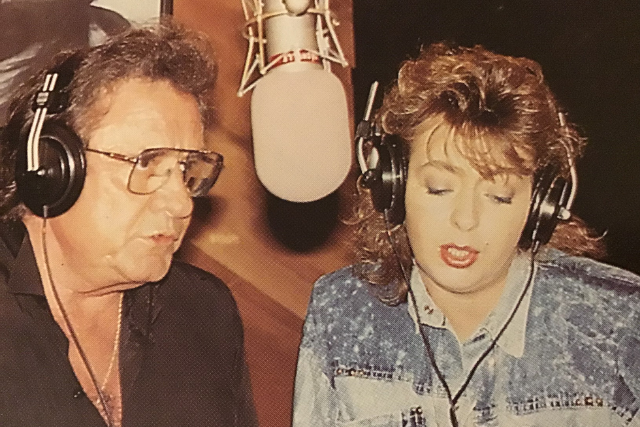
“I introduced myself to Johnny, and he brought me back-stage. He called in his band and asked if I wanted to sing some Patsy Cline songs on stage with him that night. I sang four songs with him including Crazy and I Fall To Pieces. Afterwards he asked if I had any plans to go to Nashville. I told him that I had visited there in 1984, and had plans to go back soon. He told me to get I touch when I arrived. I went over that same year, and I looked him up. He invited me out to the house to meet his family, and production team. And then he asked me to record Woodcarver with him. It was such a wonderful experience.”

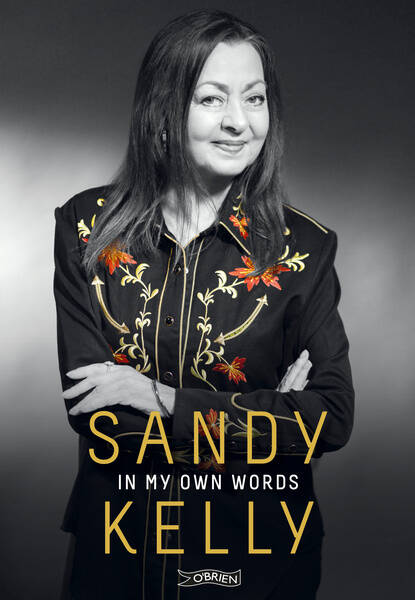
The popular Irish singer Sandy Kelly. Her grandfather was the Roadshow man Dusky Dan Ellis