Tom Duffy Circus
Tom Duffy's Circus is an Irish family run travelling circus and roadshow headquartered in Navan in County Meath It has one of the oldest ot the big tops in the world, dating back to the 18th. century. Duffy's Circus was originally founded in 1775. The Duffy family's involvement in circuses stretches back to a young shoemaker from Dublin, Patrick James Duffy, who performed as an acrobat in circuses in the 1840s in England. He had seven children, six of them got involved in the circus. In the 1870s, Duffy's second son, John, founded the John Duffy Circus. The family toured for three seasons before family divisions caused them to split in 1917 into two separate companies. Following John Duffy's death in 1956, the circus split between his son James and his uncle. By 1961, there was one company left which took another split, for Tom Duffy's Circus to come in existence. In the late 1970s, Tom Duffy became the owner and CEO of the circus.
Duffy's son David is the current ringmaster of the circus and is run by his sons, Tom and Jamie, the sixth generation of performers from their family. The circus includes acts from all over the world.
In 2018, Tom and Jamie won a Silver Clown Award at the Monte-Carlo Circus Festival in Monaco
On 20 April 2020, owner and former ringmaster Tom Duffy tested positive for covid 19 in his nursing home. He recovered one month later on 20 May. On 15 March 2022, it was announced that Duffy had died aged 92.

The Late Tom Duffy

David Duffy Circus Ringmaster


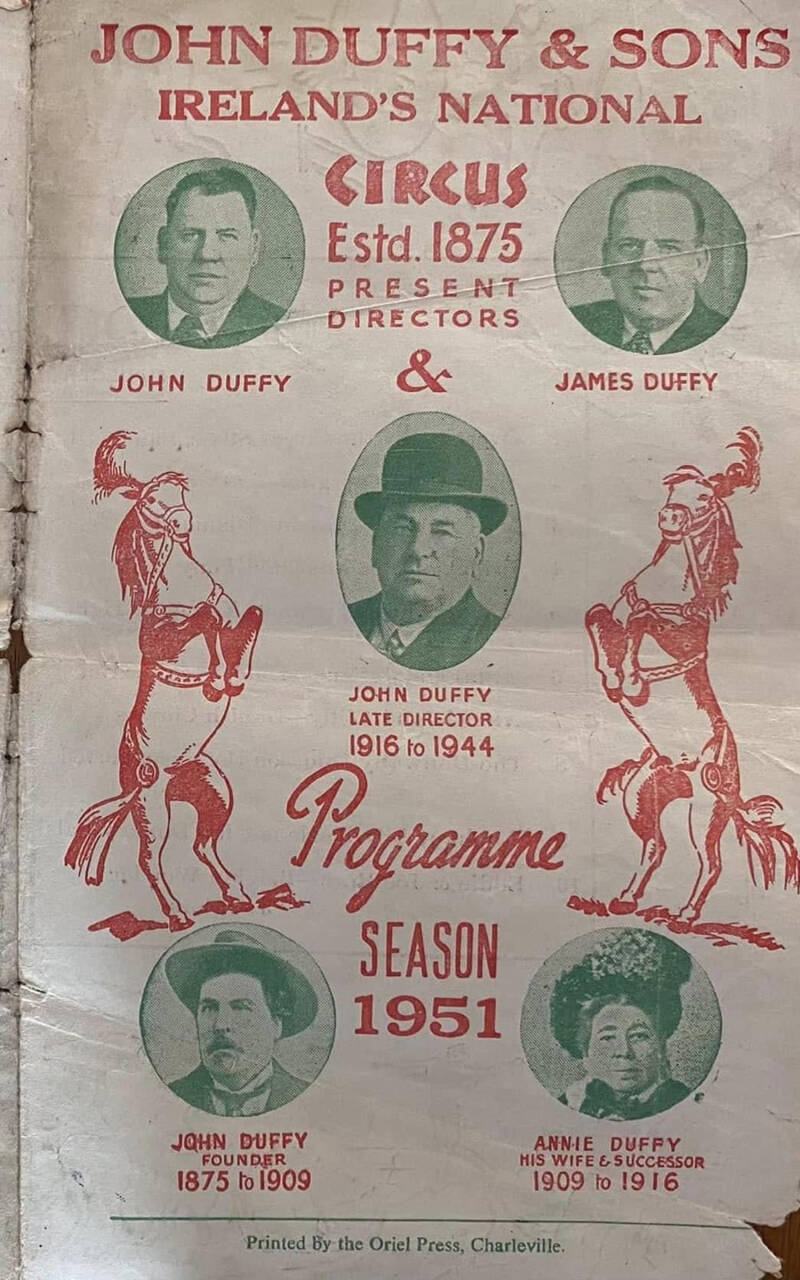
Tom Duffy – The Greatest Showman
Courtesy of The Showmans Guild
No one ever made a difference by being like everyone else. It is with great sadness and regret that the Duffy family announce the peaceful passing of Tom Duffy, Our Greatest Showman. Tom is survived by son David, daughter in law, Stephanie and his two Grandsons, Tom and Jamie and brother Freddy. Born on April 5th, 1929, in Limavady, Northern Ireland, in his parent’s caravan,
Tom was fifth born of eight siblings. He can lay claim to being one of few to have lived in almost every town, city, village and hamlet in Ireland, even if only briefly, over his almost 90 years touring with Duffy’s Circus. Tom remained on tour for many years through the toughest of times, witnessing World War, The Troubles, fighting cancer, losing his wife Gertie, and embracing the changes and modernisation of a lifestyle and art that can be traced back through his family through the last few centuries. Tom Duffy tried and mastered many of the skill sets for an amazing all-round circus star, he was articulate in the ring as ringmaster, a capable and confident horseman and a general all-round acrobat able to turn his hand to any act that needed him. He was a showman at heart and never one to shy away from the spotlight, or a microphone. In April of 1979, his 50th birthday, he, his son, David, and wife Gertie created what is the current inception of Tom Duffy’s Circus. Through the years it has seen many changes and grown from strength to strength becoming one of the largest and most respected circuses in Europe. From the early days of the horse drawn wagons to the modern new trucks and living quarters he bore witness to immense changes and modernisations within the circus and entertainment industry.
health required Tom to step back, a little, and enjoy some comfort in his care home in Dublin, though he would still come and visit when the Circus was nearby, and he was often visited by his many friends and family. Tom was always a fighter, surviving two bouts of cancer and even catching and recovering from Covid. His strong character and charisma were always part of his larger-than-life persona, a warm welcome would be given to those inside the big Top when he was there. In recent years he watched on with pride as his Grandsons, Tom and Jamie, stepped up and into the spotlight, following in his footsteps becoming a headlining act.

The Late Tom Duffy

Tom Duffy’s Circus carries the name with pride, a nod to the past and a beacon for the future. As we look now to the future without our namesake, we know that we shall strive to continue to make him proud, with advances in technology and innovation whilst maintaining a true respect for the traditional Art form of Circus. As is the wish of Tom all performances of his Circus this week will continue as scheduled.
And as Tom often said “The Show Must Go On”


David Duffy on the ‘mighty struggle’ to keep a promise he made to his dying father
Courtesy 0f The Irish Independent 24 May 2026 - Article by Rodney Edwards


Photographs courtesy; © Mark Condren
Outside Tom Duffy’s big top, cold wind lashes the canvas while generators hum. The circus has survived famine, war, recession and pandemics, but it’s not easy. Inside, David Duffy (65) looks exhausted. Sitting beneath a portrait of his late father, the heir to Ireland’s 250-year-old circus dynasty is carrying the weight of a promise made before his father died. “I wasn’t even coming out to see you today,” he says quietly as we sit to chat. “I’ve been having a bad few days because of the stress.” Founded in 1775 by Dublin shoemaker Patrick James Duffy, Duffy’s Circus is one of Ireland’s longest-running entertainment traditions, travelling the country for generations and now staging more than 300 shows every year.
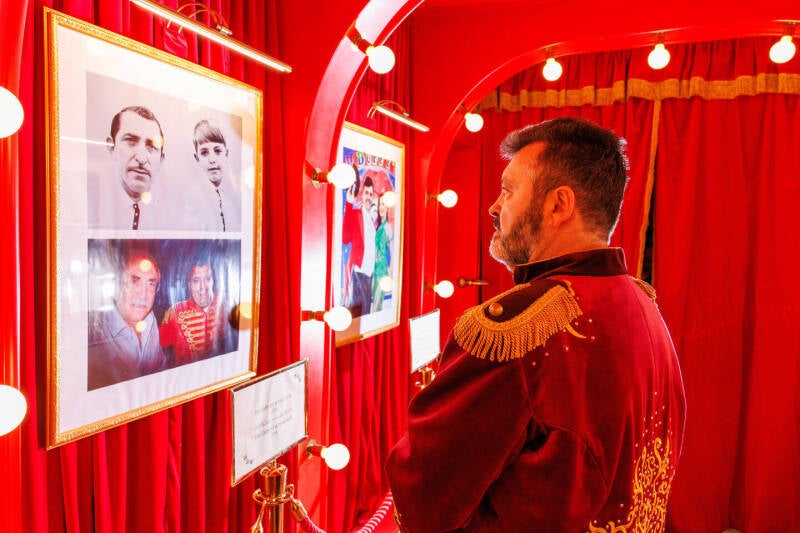
When Tom Duffy died in 2022 aged 92, his son promised the circus would survive. The name, stitched into Irish life for centuries, would not disappear on his watch. With no siblings, he feels “a huge responsibility” to carry on the family tradition. But David fears the curtain could come down before the end of this season. “We’ll be lucky to make it to October,” he says. “But I can’t do that to Daddy.”
David Duffy looking at a photo of his late father Tom © Mark Condren
Born in Dublin’s Rotunda Hospital, David grew up travelling the circus circuit with his father Tom and his mother, Gertie Sinnott, a cabaret singer who performed under the stage name Ruth Marlow. Originally from Sandymount in Dublin, Gertie came from a family steeped in performance, with her own mother working as an Irish dance teacher. David lived in Clondalkin before moving to Bray, eventually finishing his education in Naas after his parents insisted that completing school was “important”. His own sons, Tom (33) and Jamie (30), both perform in the circus, taking part in the daring Wheel of Death act. Jamie also performs the Laserman act, while Tom stars in the crossbow performance. Entertainment runs deep in the blood. David’s cousin is Keith Duffy, bass player with The Corrs, while another cousin, Paul Duffy, played saxophone with The Commitments.
His father, once a celebrated trapeze artist, spent the final four years of his life in hospital, and later a care home, after losing the use of his legs. Yet even in old age, circus life never left him. “He was a very proud man,” David says, “very proud of his name. Very proud of what he’d done.” Before his illness, Tom Duffy would sit in his director’s chair during every performance, watching the next generation perform the acts that mirrored his own youth high above the ring. “When visitors came to the show, Daddy would make sure they sat beside him,” David says.
David speaks openly about living with depression. The pressure of trying to sustain a touring circus while carrying responsibility for the dozens of people who depend on it for their livelihoods has become overwhelming. Documents show annual ticket sales for 2025 stood at €1.72m, only slightly down from €1.82m the previous year. But after wages, artist fees, transport, insurance, permits, fuel and advertising costs were paid, the circus was left with a surplus of just €39,949, down from €165,957 the previous year. The scale of the operation is enormous. Artist fees alone exceeded €551,000 in 2025, while wages totalled more than €171,000. Ground rents approached €86,000, motor expenses passed €111,000 and insurance costs exceeded €61,000. Generator fuel came to almost €60,000, while Facebook advertising neared €66,000. It now costs around €3,000 every week just to fuel their 22 lorries.
“It’s impossible,” David says. “People see the lights and the music, but they don’t see what it costs to keep this on the road.” Sitting inside the sound room beneath the canopy, he looks at the floor as he speaks. When things become overwhelming, he says he leaves the trailer he shares with his wife Stephanie and sleeps alone in the cab of one of the lorries. “Sleeping in the lorry makes me more miserable,” he says. “But I do that on purpose because it’s like self-harm. I push myself to that point where I feel as uncomfortable as possible.” He says he slept there “last night” after two performers were refused permission to continue working because of visa complications. “I feel like a failure. I feel useless, like a burden,” David says. “I’ve suffered from mental health problems for 40 years.” The depression intensified when he became ringmaster, responsible for every aspect of the travelling production. “I’d spend four hours a day trying to keep the show going, then go back to the trailer and break down,” he says.
Earlier this year, the strain nearly killed him. While dismantling the big top in Tallaght in January, he suffered a stress-related stroke. Even lying in a hospital bed, his mind remained fixed on the circus. “I was looking at the clock, thinking the show finishes at half six. The seats should be closed by now,” he recalls. “I kept texting the boys asking if the flooring was lifted yet.” The circus itself is a feat of engineering. The Italian-made big top stretches 37 metres across and 15 metres high, supported by four giant masts fitted with motors that haul the structure into place. Modern circus life is far removed from old stereotypes. They no longer use animals. Instead, performances rely on sophisticated lighting systems, computerised sound cues and tightly choreographed theatrical production. Every spotlight must be recalibrated whenever the show moves town. Precision matters. Cameras monitor both the ring and the audience entrance. Five separate WhatsApp groups coordinate performers, management and technical crews during every show. “Jamie will message if someone on the door isn’t smiling enough,” David says.
For decades, he was the face of the circus himself, appearing as ringmaster in a top hat and gold shoulder pads. Now that role belongs to his daughter-in-law, Candice, married to his son Tom. Inside the sound room, another photo of Tom Duffy hangs above a chair scattered with toys belonging to Candice’s daughter Charlotte, David’s first grandchild. Candice returned to the ring just five weeks after giving birth by emergency caesarean section last year, taking part in a crossbow act beneath the lights. For her, circus life brought stability she never experienced growing up in Warrington, England.
“I moved 13 or 14 times before I was 16,” she says. “People think circus life must be unstable, but this is the most stable home I’ve ever had. When I say this circus saved my life, I mean it.” Earlier this year, only days after his stroke, David walked Candice down the aisle at a ceremony in Dublin when her own father could not do it. “Everybody screens me from things, especially Candice,” David says. “They keep problems from me like I used to keep things from my dad.” Candice adds, softly: “We have to.” But some problems cannot be hidden. During the Covid-19 pandemic, the industry collapsed almost overnight. Touring stopped entirely. Big tops stayed folded. Families who had spent generations moving from town to town suddenly found themselves stranded without income. Eventually, David secured a meeting with then tánaiste, Leo Varadkar. Frustration flashes across his face at the memory. Government advisers listed support schemes one after another, only to conclude the circus industry did not qualify for them. Then came the final suggestion: “Well, you can get the PUP [pandemic unemployment payment], can’t you?” Candice says the public rarely sees the enormous financial and logistical pressures involved in keeping a traditional travelling circus alive. She says Tom Duffy’s Circus costs around €40,000-a-week to operate, with soaring fuel prices placing unprecedented strain on the family-run business. Fuel costs alone have risen by more than 40pc since March, dramatically increasing the expense of powering generators, heating equipment and transporting the circus from venue to venue. “We use an unbelievable amount of fuel,” she says. “People see the lights and performances, but they don’t see the generators running around the clock or the cost of moving an entire village every week.” The circus currently travels with 22 lorries and around 30 additional trailers and support vehicles, requiring double journeys to move everything between loca Maintenance costs fluctuate weekly, ranging from €500 to €3,000, covering tyres, windscreens, oil and repairs caused by rough or unsuitable sites. “We are increasingly being pushed on to private sites on the fringes of towns,” Candice says. “That means softer ground, more damage to vehicles and equipment, and higher maintenance bills.”
They employ 27 full-time staff, alongside short-term contractors including choreographers, HGV drivers and advertising crews. The circus also covers accommodation, travel, utilities, costumes, insurance and visa administration for performers from across the world. Despite being recognised as part of Ireland’s intangible cultural heritage, Candice believes traditional circuses are being failed by public bodies.
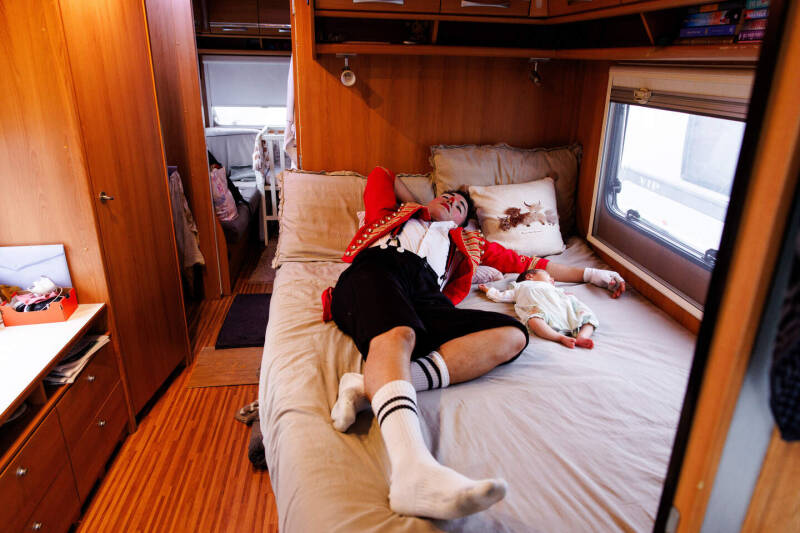
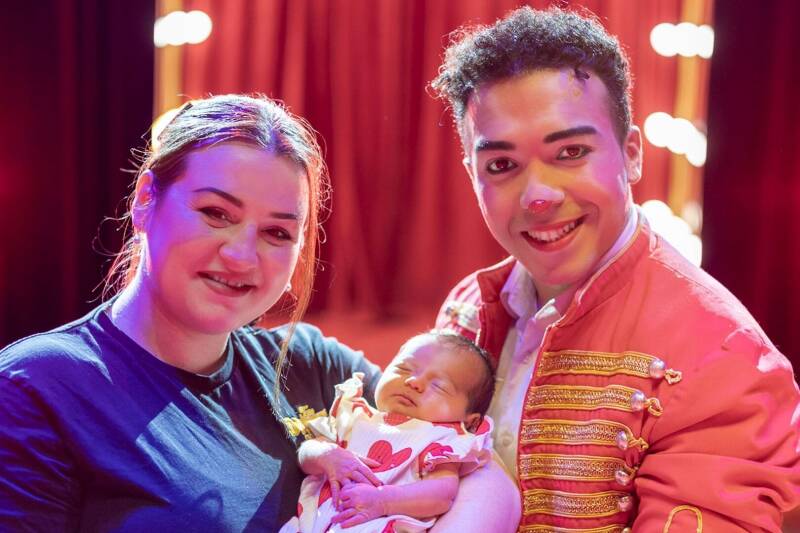
Brazilian clown Maycon Fernandes, now in his third year with Duffy’s, has become one of the most recognisable faces of the show. “When I put the make-up on, I become the character,” he says. “People don’t need to understand words to laugh.” This year, he and his wife Carina welcomed their daughter Leona, a sixth-generation circus child. Carina, from a French-Argentinian circus family, performs a traditional gaucho act with her parents. “This life is all we’ve ever known,” she says. Her mother, foot juggler Germaine Delbosq, now travels alongside both her daughter and newborn granddaughter. “It’s been so emotional,” she says. “The Duffy family have been amazing.”
Clown Maycon from Brazil and his wife Carina welcomed their first baby Leona into the world at Letterkenny General Hospital in Donegal. Circus ringmistress Candice Duffy stepped in for Maycon
Photographs courtesy; © Mark Condren
Dancer Jade Lee describes the atmosphere behind the scenes as unlike anything she has experienced elsewhere in the entertainment industry. “They feel like a second family,” she says. “They told my mum, ‘Don’t worry, we’ll look after her’, and that’s exactly what happened.”
Spanish strongman Leo Cristina lifts a hand to the image on the side of his head — the face of Thor, the Norse god of thunder, inked in black against his scalp. Inspired by Viking symbols of protection and luck, it has become part of the character he brings into the ring every night. “It brings me luck everywhere I go,” he says. “It’s like my superhero character.” Leo comes from the famous Cristina circus family, owners of Circo Cristina in Italy, but this is his first season with Duffy’s. “When I told my family in Spain I was joining Tom Duffy’s Circus, they said: ‘Wow, you are going to the best circus in Ireland’. I’m very proud to work here.”
For Brazilian performer Letitia, circus life began after attending classes as a teenager. “I remember thinking: this is what I want to do,” she says. What keeps her performing, however, is the connection with audiences. After one recent show, a mother approached to thank her for inspiring her daughters. “She said it was the first time they’d seen a woman doing such a strong act,” Letitia says. “Now they believed they could dream bigger.”
