Albert Daniels - Showman
By: Joe McGarrigle (The Donegal Democrat)
March 29th 1991


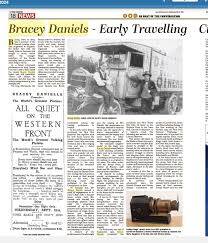
I am sure that some readers still recall with nostalgia the annual visit of the Bracey Daniels touring cinema to their town or village. This was an eagerly looked forward to event, and the excitement and anticipation as the day of their arrival approached was not confined to any one age group. To us youngsters crowded around the Temperance Hall. No philharmonic orchestra could create music as sweet as ihe steady thudding of the generator mounted on a lorry: it meant that weeks of waiting were at an end. During their stay, which usually lasted two weeks, the people of the town got to know the entire entourage by name. Of course, the Daniels family had been regular visitors to the town for many years, some of them since they were children, and they were greeted as old friends and were very popular with everyone. It gave me great pleasure, therefore, to meet Albert Daniels again when he came to Donegal to launch his book "Five And Nine, published by the Donegal Democrat. From cover to cover it is a nostalgic trip down memory lane . . . a tale told in masterly fashion by one who loved his craft. I could do no better than to quote from the forward to the book, written by Cecil A. King. "What he has recorded here as a result of his musings makes a thought-provoking demonstration of the metamorphosis that has made life so strangely different now from what it was in the early and mid-decades of this century".
I would seriously recommend this very informative and entertaining book to anyone wishing to re-live the happiness of leisure hours spent in the wonderland provided by Bracey Daniels and his confreres of a generation long past, or indeed lo a younger generation so that they may realise in some small way what they've missed. I renewed acquaintance with Albert Daniels in the home uf a mutual friend. He and his son Bracey — "There'll always be a Bracey Daniels" — were staying with Elizabeth Gucrtz in her home outside Donegal Town.
The Daniels family have a very close association with this county. Albert's parents and grandmother are buried in the Rock cemetery in Ballyshannon. His eldest daughter Susie was born in Stranorlar. A grandson was born in Donegal District Hospital, a daughter, Clarice, married a young man from Dunkineely. Peter Cunningham, who sadly died in a tragic accident in London, and Albert confesses that he found his first serious love in a small town in South Donegal. He was at St. Malachy's College in Belfast at the time and was holidaying in the village where his father was showing films. As their love blossomed the desire to get married became all embracing. They approached the girl's uncle, a parish priest, for advice. Giving them his blessing he suggested Albert should take advantage of his college education and look for a job that would provide "greater stability than a touring cinema". Albert took his advice, and since he always had a desire to become a radio officer at sea he applied for acceptance to the Maritime College in Cardiff, and to his delight got a place there. He showed great promise while he was there and it looked as if he was destined for a life on the ocean wave, but, alas, family circumstances decreed otherwise and Albert had to break off his studies and come home to help his father run the family show. Life on the road, moving from town to town, was not conducive to fostering a romantic relationship so Albert and his Joan drifted apart, but even yet his thoughts often stray to his first love and the happy hours they spent in "that picturesque little village in Donegal". "How long is the family in showbusiness", I asked. It all started with Albert's grandfather. He owned a very lucrative tobacco business in Birmingham in the 1800s and a small estate "Dutton Bassett". He loved the circus and travelling fit-ups and was known to entertain the different show people who came to perform in his area. To the dismay of his family he sold out all his property and business interests and bought a circus. Alas, it ended in the age-old way — "a fool and his money". His quiet love of show business was no compensation for lack of practical experience".
But the wiseacres did not have the satisfaction of saying he has learned his lesson, for the tobacco merchant had burnt his boots, and he followed his heart, not his head, and took up with the famous Lord John Sanger's circus. His sons. Bracey and Clarence, who were born into the circus, acquired their father's love of the "sawdust ring" plus a talent he lacked. They appeared at a Royal Command performance at Windsor Castle and were personally commended by Queen Victoria, who told them. "There will always be showmen, but few have the artistic temperament of your youthful self. These words are quoted from a report of the occasion in "World' s Fair" 1955 by a Mr. Teddy Munroe, writing about the performance given on July 13th, 1893.
Shortly after this the Daniels family crossed to Ireland where they established a dynasty of showpeople in circus, films and stage entertainment. Bracey retained the name Daniels. Clarence — or Clarric as hc was known throughout the length and breadth of Ireland — took his mother's maiden name, Bailey, which later became well known in dramatic and variety stage shows, and led eventually back to their original roots, the circus, in the U.S.A. and Ireland. That great artist of film and television fame, the late Harry Bailey, was one of the clan. Initially the family started off in Ireland with a magic lantern show. I suppose in a way this was the forerunner of the movies. During the showing of slides grandfather Daniels would give a running commentary describing the scenes on (he screen. This gave him an opportunity to exercise his flair for the imaginative. Albert still has a number of these slides — "priceless mementos".
Next came the Daniels Touring Cinema, which was to become something of an institution in Irish showbusiness. Young Bracey, as he was then, became intrigued by the new entertainment phenomenon that had come to Ireland. A Frenchman, Professor Jollcy. brought a projector and some films to Dublin and set up what was the first movie cinema. He was followed some lime later by a German who also opened a cinema. Both projects failed. Meanwhile the Daniels family was carrying on with their magic lantern/variety show until Bracey made the decision to move into the new age and meet it head-on. He bought a projector and arranged for a regular supply of films and set off around the country. His gamble paid off— the name Daniels became synonymous with the touring cinema, the first of its kind. Projectors in those days were, by modern standards, primitive pieces of mechanism. They had to be hand cranked. The lighting system too left a lot to be desired — in fact it could be lethal if one recalls the terrible tragedy at a cinema showing — nothing to do with the Daniels show I hasten to add — at Dromcollogher. There was a general tightening up on cinema operations after that.
Motor transport was still some way off and the show travelled by horse-drawn vehicles. One gets some idea of the hardships those early pioneers endured by listening to Albert recount some harrowing experiences of his father in getting the show to remote country areas in bad weather. It came as a surprise to me to learn that colour was introduced into films almost 70 years ago. Albert recalls seeing a silent film — "The Life of Christ" — in colour when he was a young boy, and it caused some amusement at the time to see the Archangel portrayed wearing gaudy striped socks. Neither is the 3D technique, the comparatively recent innovation I had thought it to be. He remembered his father showing 3D films in 1914. He and his late brother, George, used to stand at the door handing out the glasses.
Bracey Daniels prided himself on being a pioneer in every field of cinematograph entertainment — Magic Lantern — silent films, and eventually the "talkies" as sound films were first known. In the beginning of the 'thirties he bade goodbye to the old medium and replaced it with the sound of Al Jolson and others of the era. It was perhaps a symbolic gesture that prompted him to make the transition overnight, giving the people of Roscommon the rare opportunity to weep at the end of an era and rejoice at the birth of another.
I'm sure my readers will be interested to know that it was George Coats who was first lo take to the road with sound. Years later George and his partner Gerry Lucy set up a semipermanent cinema in the Temperance Hall, then known as Chapman's Hall, in Donegal Town. George, his wife, and son Ernie, lived in Upper Main St. They divided the week's showing between Donegal, Ballybofey and Killybegs. Albert told me that George, who was a very clever technician, build his own sound equipment for an outlay of a few hundred pounds. Bracey Daniels had to pay several thousand pounds for his equipment. Paradoxically it was the success of the movies, built up by people like Bracey and Albert Daniels, George Coats, Carron Brothers, and Billy Walsh, that led to their disappearance from the circuit. A demand was created for regular viewing and this in turn led to permanent cinemas being built in first the bigger towns and eventually in every town and village in the country. There was no need for touring cinemas.
For many of the old timers this provided an opportunity to take a well-earned rest but Albert was too young to consider this alternative, and even though his education equipped him to take a responsible position outside entertainment (which he did at a later date) he decided to remain with the business he knew best. One of his most successful enterprises was a children's Special talent contest held in conjunction with Radio Eireann. An old friend of mine. John Ross, who in later years was widely known for his television news reports, was the link man. Albert also joined International Films Ltd. and this was to provide him with one of the most intriguing incidents of his career. He was asked to go to the home of the German Ambassador in Dublin, Herr Hempel, and show a special film for members of the German group living in Dublin. Naturally Albert assumed the film would have some cultural significance but to his surprise it was a series of naval engagements shot in the first World War. That was 1937. It was not until war broke out two years later that Albert realised the real significance of the film.
Despite the last curtain call for the Daniels Touring Cinema the family name continued to come before the Irish people. Who can forget the great variety show introduced to the towns and villages of the county by George Daniels. Even today "Noreen Bawn". immortalised by George in the play of the same name is as popular as when he introduced it to Donegal. We also remember with fondness the Dorothy Daniels Dublin Players, managed by her son Bracey. and in common with thousands of others all over the country we queried for admittance to his own play "Maria Goretti". When he writes his memoirs he will surely include the lovely story he tells about a beautiful summer's evening when he was rehearsing in the Rock Hall, Ballyshannon, and looking out of the window he saw the sun glinting on a headstone in the cemetery just outside the hall. To his surprise he found himself reading his name "Bracey Daniels" on the headstone. It was the grave of his grandparents. It was an emotional moment for young Bracey. He suddenly remembered the reason why their grandparents had chosen that cemetery for their last resting place. "My grandmother believed there would always be shows coming to the Rock Hall and performers would have an opportunity of perhaps paying a visit to the family grave and in this way perpetuate the memory of Daniels". Alas the travelling shows have disappeared — the Rock Hall no longer resounds to the applause of appreciative audiences — but the name Daniels is too deeply imprinted on the culture of Donegal to be forgotten. Albert is now living in retirement in England.

